



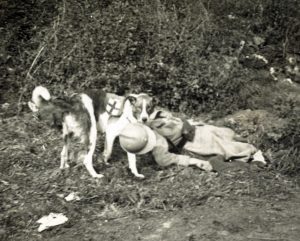
World War One saw the widespread use of war dogs by multiple combatant nations. When the United States joined the war in April 1917, dogs performed multiple tasks on the battlefields of the Western Front in France. By the end of 1917, several resources appeared on use of war dogs in France. American Red Cross observer Theo F. Jager published “Scout, Red Cross, and Army Dogs: A historical sketch of dogs in the Great War and a training guide for the rank and file of the United States Army“. Jager’s work is one of the earliest reviews of the abilities of dogs on the 20th Century battlefield. The following are excerpts from that book:
Sentinels
That efficient dogs can aid materially in accomplishing the success of units is an established fact. The lonely soldier on guard, who for the first time faces the dark shadows with their lurking dangers in the enemy country, will do his duty better and more fearlessly if a faithful dog is with him to warn him of impending events. With such a four-footed comrade reconnoitering the nearby landscape, the immediate danger, the personal danger is alleviated, the sentinel can confine himself to observing or watching for things further ahead and thus prove of better service.
Again, if danger threatens a double sentinel, the men can remain and observe its development, while their four-footed comrade is dispatched back to the sentry squad or picket commander, to report and if needed for support.
Editor’s note: Jager points out the morale-boosting and calming effect that war dogs have on the troops they serve with. Beyond their physical contributions on the battlefield, war dogs can provide important emotional support to their human comrades.
Red Cross dogs
The battle being over, ambulance details and Red Cross helpers need not fear that they will overlook wounded soldiers when dogs are employed to trail them.
The dead and badly wounded are easily found, they lay where they fought, but the lightly wounded, those that had still strength to crawl and seek shelter or water to quell their thirst, are the ones that the hospital corps is apt to miss.
Speaking from the viewpoint of military efficiency these slightly wounded are the very soldiers that should be specially cared for, as on their speedy recovery they may prove in a long-drawn-out war the deciding factor that will end it, when they have again returned to the fighting line. Good Red Cross dogs will quickly clear a battlefield of all wounded soldiers.
That dogs can reduce the permanent losses of an army to a considerable extent is thus proved beyond all doubt.
Editor’s note: Timely location and evacuation of wounded troops saves lives. Even today, war dogs perform this valuable service and help keep more American troops in the fight.
Dogs of War
As long as we sanction the use of savage and cruel weapons against men, why should not man’s best friend, the dog, be given a chance to aid his master?
Man, no matter how daring or brave, has not lost his natural dread of being thrown down and chewed up by an infuriated dog, especially if such dogs have been trained right to take the proper hold to overcome resistance.
Editor’s note: In the right tactical situation, the aggressive power and tenacity of the American war dog is a potent weapon.